

Where to Stay in Puerto Escondido | 6 Weeks in La Punta
Updated: 2 days ago

IIf you're wondering where to stay in Puerto Escondido, the short answer is: it depends on what kind of atmosphere you're looking for. Puerto is a long, narrow stretch of coast, and its neighbourhoods feel surprisingly different from one another — from the more local feel of Centro to the beach-focused areas around Zicatela and La Punta.
When we visited in 2023, we spent time wandering around the different parts of town, which gave us a good sense of what each area has to offer. If you're staying for more than a few days, it's worth exploring a little before choosing where to base yourself.
At a glance
|
Finding a place in La Punta
If you're heading to Puerto Escondido for more than a few days, it helps to know how the neighborhoods differ before choosing where to stay. We only lived in two of them, so the other two are based on walking around rather than living there, but this is how they felt to us:
Centro: the busy downtown, with markets, shops and plenty of places to eat.
La Punta: bohemian and easygoing, with hostels, surf schools and food right by the beach.
Zicatela: the big surf beach and the center of the nightlife. Busier, louder and more geared towards visitors.
Rinconada: quieter and more residential, around Playa Carrizalillo, with a handful of cafés and shops.
Brisas de Zicatela: the newer, more residential area behind/around La Punta, with lots of accommodation and an increasing number of cafés and businesses.
Quite a few foreigners have settled in Puerto for a while, including retirees, digital nomads, artists and people who've started businesses here. You notice it in the cafés with good WiFi, the international food scene and the amount of English you hear in shops. It makes Puerto relatively easy to settle into if you're arriving from abroad, especially if you need to work while you're there.
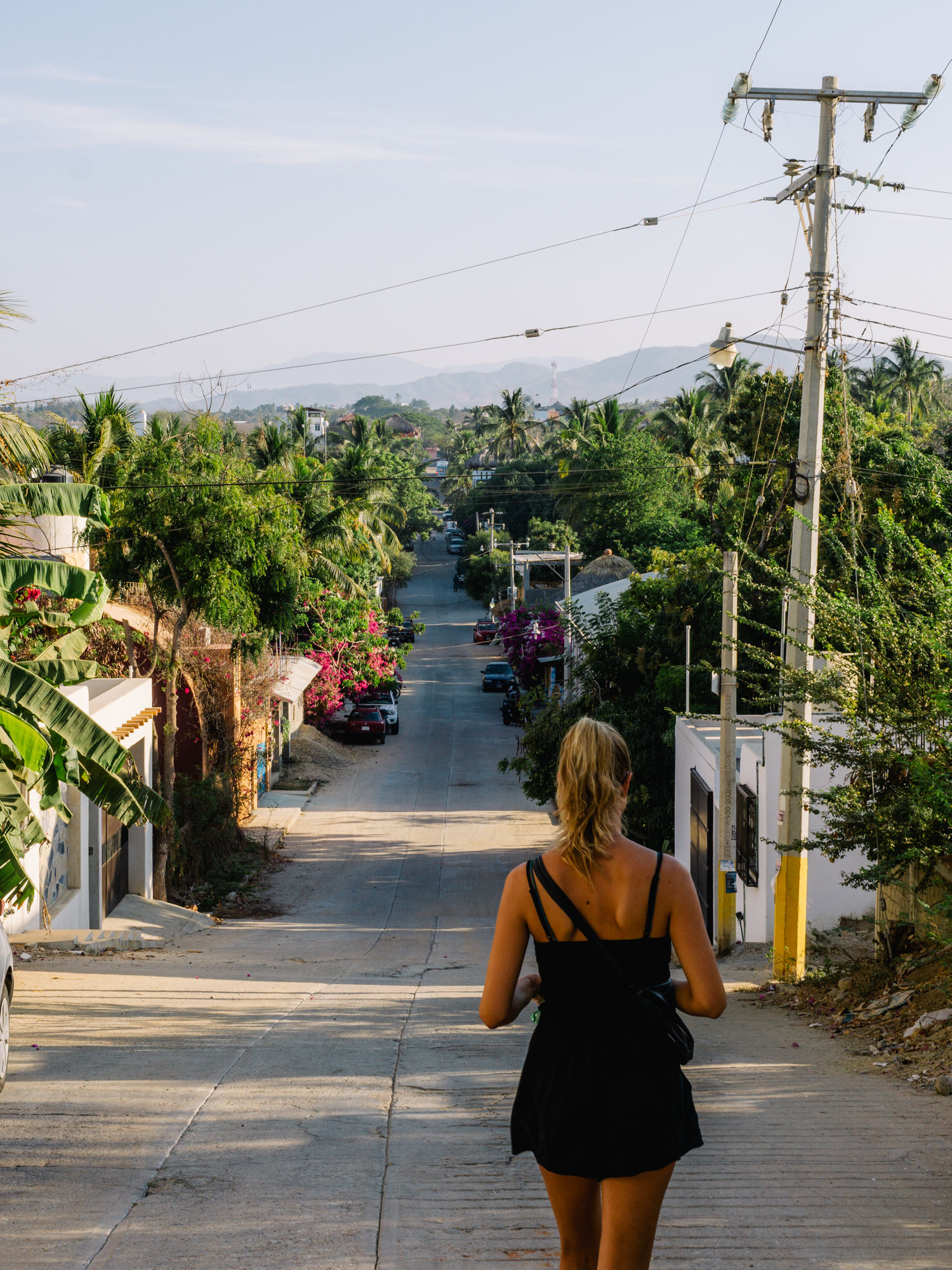

We were part of that crowd for about six weeks ourselves. We also recognise that a growing foreign population can push up local prices, while tourism brings in income that many people depend on. It's a complicated trade-off: the same changes that can make a place more expensive can also create jobs, support local businesses and bring money into the community. There's no easy way to separate the two, but it's worth being aware of this balance when choosing where to stay and how you spend your money.
Our advice: book one week first
If you're unsure about a place, we'd recommend booking a week rather than committing to a month straight away. It gives you time to test the things you can't really check from a distance: the neighborhood, the noise, the internet, the electricity, the walk to the beach, and whether you actually like the place once the novelty wears off.
That's what we did. Our first few days in Puerto were mostly about looking around. We scrolled through a few platforms, and eventually found a Facebook post for a room in a house just outside the busy part of La Punta. We'd already walked around La Punta and liked the feel of it, but we didn't want to sleep right in the middle of the touristy area.
The house was close enough to walk into La Punta, far enough out to feel like our own little corner, and just a minute from the beach. It had only just opened: bamboo and natural materials, a handful of private bedrooms, a shared kitchen and lounge. The idea was coliving, which turned out to mean less "renting a room" and more moving in with a few friendly people we'd never met before.
We booked one week to start. La Punta has a reputation for unreliable WiFi, and we didn't want to commit to a month based on a hunch. As it turned out, the WiFi held up well. The electricity was less reliable. It went out two or three times during our stay, never for long, but each time the whole neighborhood went dark along with us.


We liked the place enough that one week became two, then three, and eventually five.
By the end, we'd found something that was harder to judge from a listing: a place that felt easy to live in. And that's probably the best reason not to book too far ahead. You can research a neighborhood from home, but you only really know if it works for you once you're there.
Puerto Escondido in March and April: Hot, Dry and Slow
We arrived in March and stayed into April, the tail end of the dry season. That's still high season, so we weren't fully dodging crowds, but the rains don't start until around May. In six weeks we got one shower, and for once, we welcomed it like an old friend.
The heat set the pace of everything. Temperatures here sit between about 24 and 32°C all year, and in April that meant warm days, warm nights and sun every single day. At midday the streets and some of the beaches nearly emptied out, and then, as the sun got low, everyone drifted back out.
We've read that the rainy season brings short showers late in the day and sun for the rest of it. We haven't seen it ourselves.
The big, famous Zicatela waves — the ones that have earned Puerto Escondido its nickname, the “Mexican Pipeline” — roll in roughly between May and August, drawing experienced surfers from around the world. They were just starting to build as we were leaving. In our last week, we got up early, walked down to Zicatela, picked up a coffee and watched the surfers take them on. If you're a beginner, it's not the place to learn on a big day, but there are plenty of surf schools and calmer beaches around town where you can start. La Punta is the more popular spot for beginners, with plenty of surf schools and lessons. It can get pretty busy in the water here, though, since so many people come to Puerto Escondido specifically to learn to surf.
Days in La Punta
The long beach between La Punta and Zicatela became our sunset spot. Almost every night we walked down, for a bit, or for a while, sometimes with a beer, sometimes with friends, sometimes both. We watched the beach slowly fill up as the sun slowly went down.


La Punta's own beach, a minute from our door, isn't great for swimming. You can wade in and enjoy the water, but the currents are sometimes strong, so stay alert. The beaches in Centro are the better ones for a proper swim, which is exactly why they're usually busier:
Playa Carrizalillo and Playa Manzanillo, near Rinconada, with calmer waters and good for swimming and snorkeling.
Playa Principal in Centro is the more traditional beach, with seafood restaurants lined up along the shore.
We went surfing a few times as well, at a quieter beach east of the city. The waves were smaller and gentler there and there was almost nobody in the water, which is a good place to be a beginner.
The days are slow, but parts of town wake up after dark. Most of the bars and beach clubs are around Zicatela, and they draw locals and travelers alike.
Our tip There's a free movie night on Bacocho Beach every Wednesday (from November till April), starting somewhere between 6 and 7 pm. Bring a towel or a pillow to sit on, and enjoy the show.


Beyond Puerto
Bioluminescence in Manialtepec Lagoon, at night. We were invited on a night tour to Manialtepec Lagoon, about a 30-minute drive from our house. We set off around 8 at night, with a pickup arranged right in front of the house, and were driven to the edge of the lagoon. You can also go on your own. Most of the tours start from the town of Aguaje del Zapote. From there a boat took us out, through tunnels of mangroves, to the right spot in the lagoon.
The water was very warm, and it was completely dark all around us. The moment you moved, the water lit up blue around your skin. Anything that moves sets it off: every kick, every arm stroke, the ripples spreading from the boat, even a passing fish. We swam around the boat for a while, wrapped in warm water that glowed around our bodies. It felt surreal. The phenomenon depends on the weather and the moon. The new moon phase offers the darkest skies and the brightest bioluminescence, so it's worth checking the conditions before you go.
Two things worth knowing before you go. Crocodiles live in the lagoon, as part of its natural ecosystem, and the tour operators keep everyone safe by steering clear of the areas where the crocodiles nest.
The glow itself is also delicate. Chemical products harm the bioluminescent plankton, so skip the sunscreen, lotion and insect repellent until after your swim, and put them on again once you're out of the water.
Chacahua, for a weekend. It's about two hours from Puerto, and its lagoon is known for bioluminescence too. We camped right on the beach, hosted by a local family, in a small village with a few shops selling the basics. Life moved at a slow pace, very different from what we're used to at home. In the morning the sun came up over the bay with the mountains behind it, a beautiful way to start the day. It became one of our favorite places in Mexico, and it has a post of its own: a weekend in Chacahua.

Mazunte, for another weekend. We took a bus along the coast. We'd barely arrived when a boat owner on the beach asked if we wanted to join his tour, so we signed up for the following day. We saw turtles and dolphins — lots of them — moving in big groups around the boat. We watched from the deck and then from the water too. After several unsuccessful attempts to get into the water and see the dolphins while swimming, we finally got lucky on our last try: a group of dolphins swam straight towards us, looked right at us for about three seconds, and then sped away. The sunset spot in Mazunte is a 20-minute walk from the center, and because it's popular it gets very crowded. We went anyway, and the walk itself was nice. Find more on Mazunte here.
Atotonilco Thermal Baths. A local friend took us to the hot springs in the hills behind Puerto. We drove to San José Manialtepec, parked the car and walked from there. The hike took somewhere between an hour and an hour and a half, through jungle and over sandy paths and rocks. The route was only partly shaded by the trees. During the hike we had to cross the river two or three times on the way there. Up at the springs there are four or five pools, each at a different temperature, ranging from warm, to hot and very hot, especially with the air already over 30 degrees. If you go, shoes/sandals that can go through water would help, we didn't have them, which meant taking our shoes on and off multiple times.
A Sunday river walk. On another day some fellow travelers gave us a ride into the countryside, about 40 minutes away. The instructions were pretty simple: park right after the big mango tree once you passed the village, which is exactly what we did. It wasn't an official hike or route, just a river stroll on a Sunday morning. After a short walk along the river we found a swimming spot, around Quequestle River Beach. The water was cold and refreshing.
Around Puerto you'll also find wildlife tours, turtle conservation centers and more jungle and river trails to hike, and traditional festivals are held throughout the year. If your stay is long enough to catch one, it's a good way to meet people and see local life up close.
The daily stuff
Getting around. One long main street connects all the neighborhoods, and colectivos run up and down it all day. Colectivos are shared vans that are an easy, cheap way to get around: just stand on the side of the road, put your hand up, and if the van is going your way, it’ll stop and you can jump in. The price is usually posted inside the colectivo, so you can check it when you get on; when you’re ready to get off, just tell the driver or signal, and pay as you leave. They generally run along the main roads, so it’s easy—one side of the road goes one direction, the other side goes the opposite way. ach neighborhood is very walkable, so you can easily get around on foot. For longer distances, scooters and bikes are widely available to rent.
Money. The currency is the Mexican peso. There are banks, ATMs and exchange offices, and plenty of places take cards, but markets and small shops want cash. Shopkeepers across Mexico often can't change a big bill for a small purchase, so carry small bills and coins. We compared ATM fees and found Citibanamex and Santander the cheapest. Both have ATMs inside some of their branches, and you'll find ATMs from several banks inside Chedraui.
Groceries. Chedraui, the big supermarket, is in Centro, on the opposite side of town from La Punta, so we only went about once a week, for things the small tiendas didn't carry. For fresh produce we used the Benito Juárez market while we were staying in Centro, a big, partly indoor market. Once we'd moved to La Punta it was quite far for a quick run, so we switched to El Adoquín market in Zicatela, which also sells crafts, clothes and jewelry. next to bread, vegetables and fruit. To stay even closer to home, we often went to Frutas y Verduras de la Costa, on La Punta's main street.
Laundry. There are lavanderías all over La Punta, usually with big signs to draw people in. We used one around the corner from the house at about 20 pesos per kilo. We dropped the laundry off and picked it up the next day. Quick and easy.
Food. Puerto's food starts with the sea, so expect fresh seafood and a lot of tacos. The markets and streets are where you'll find the Oaxacan dishes. The international side is wider than we expected, from Italian pasta to Japanese sushi, probably because of the foreign crowd that comes here. Fish tacos show up twice on our list below, which tells you something about how we love them.
Where we ate
La Olitá: the best fish tacos and drinks
Pepe's fish tacos: more great fish tacos
Mercado Zicatela: lots of lunch options under one roof
Espacio Cometa: outdoor food court, different cuisines
Alaburger: burgers, pizza, drinks
Nodo Brewhaus: beer and food
El Cafecito: coffee to go, lunch
Dulce Tierra: coffee, lunch, pastries


Is Puerto Escondido worth it?
Yes, very much in our opinion. What we remember is the simple routine more than any single sight: groceries from the same little shop, laundry around the corner, sunset on the same stretch of beach every evening, the sea a minute from the house, and the people we kept running into. Somewhere in those weeks Puerto stopped feeling like a place we were visiting and started feeling like a home away from home, which is what we hope for from a long stay.
A few small things worth noting, although it's nothing that really got in the way. It was hot all day, every day, and it stayed warm long after dark, so build your days around the heat and take it slow when needed. We didn't have air conditioning, but the openness of the house and a fan went a long way. Now and then, the power went out across the whole neighbourhood, so it helps to be prepared: have a WiFi backup for the daytime and a light for the darker hours. Also, the best beaches for an easy swim are the somewhat busier ones in Centro. We regularly went for a dip in front of our house, but the water and waves can be a lot here.
We did think about extending our stay — we could have stayed for a while longer. However, our trip had other places on the itinerary, so we had to say goodbye to the house in La Punta and move on.
If you're weighing a stay like this, our advice is the same as at the start: book a week, see how it feels, and let the place decide whether it turns into one week or five.
Puerto Escondido is a popular place, and for good reason. Like any place that attracts more visitors, there’s the question of how much that popularity will eventually change it. We didn’t really feel that tension during our stay, though — especially in the neighbourhood where we lived. Once you've stayed long enough to know which shop has the best vegetables, where to watch the sunset, and the little routines that make a place feel familiar, it turns into something more than a surf town. Start small, and give it longer than a weekend.


